

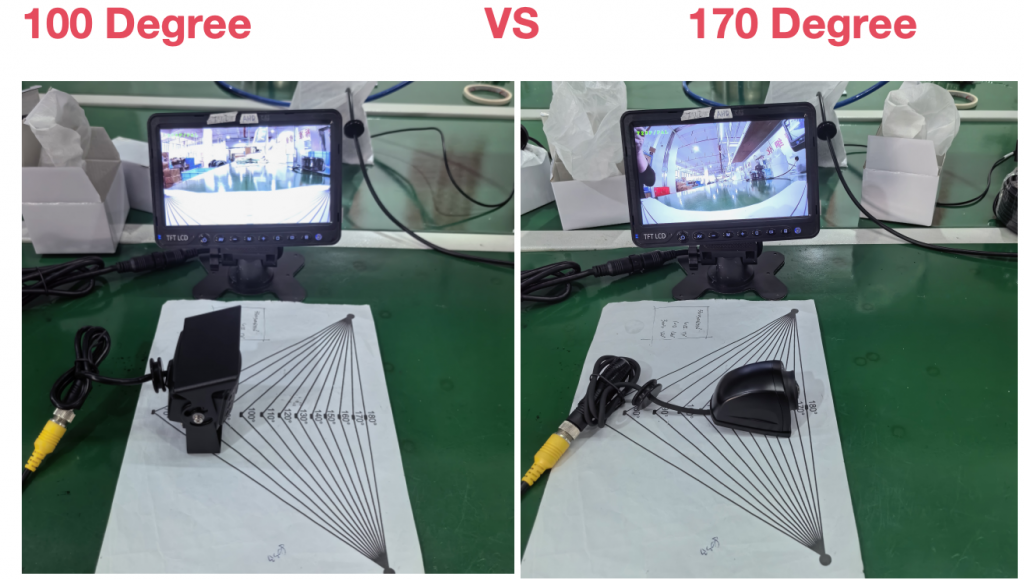
Rear View Camera: 100° or 170°? A Clear Explanation from Field of View, Blind Spots, to Distance Judgment
When installing rear view cameras on commercial vehicles, construction vehicles, forklifts, pickups, and RVs, one of the most common questions customers ask is:
“Which is better for a rear view camera—100° or 170°?”
Let’s state the conclusion upfront: There’s no absolute “better” option—only the one that’s more suitable.
You need to first determine what the customer cares about more: “more accurate distance judgment when reversing,” or “wider field of view and fewer blind spots.”
This article provides a simple and practical selection method based on field of view range, image distortion, installation height, and typical application scenarios.
1. The Core Difference Between 100° and 170°: More “Accurate” Vision or Wider Coverage?
100°: Better for distance judgment and clear details A 100° angle is a moderate wide-angle view with less image distortion and more natural object proportions.
Best for users who: Prioritize easy control during reversing and accurate distance judgment.
Main advantages:
- More realistic depth perception: Easier to judge how far the rear of the vehicle is from obstacles
- Clearer details: Objects appear larger at the same distance, making them easier to identify
- Less edge distortion: More comfortable for the eyes, reducing fatigue during long drives
170°: Better for maximizing coverage and reducing blind spots A 170° angle is an ultra-wide view that covers more area left and right, leaving fewer blind spots.
Best for users who: Prioritize safety coverage in complex environments and want to “see as much as possible.”
Main advantages:
- Wider field of view: Captures more of the areas on both sides behind the vehicle
- Fewer blind spots: Ideal for narrow roads, mixed pedestrian/vehicle traffic, warehouses, and docks
Note: The wider the angle, the more noticeable the edge distortion becomes. Objects may appear farther away, making distance judgment more reliant on guide lines or radar assistance.
2. When to Choose 100°? (Recommended Scenarios)
If the customer cares more about “stable reversing and accurate distance,” 100° (or 100–120°) is usually the better recommendation.
Scenario A: Long vehicles/trucks/vans reversing into loading bays or docks The longer the vehicle, the more critical accurate distance judgment becomes. A 100° view feels more natural and makes reversing easier to control.
Scenario B: Camera installed at a higher position (high-mount rear view) High mounting already provides broader coverage. Adding a 170° lens would make distance judgment even harder.
Scenario C: Nighttime reversing or low-visibility conditions (rain/fog), where clear details matter most A 100° view is more “zoomed in” and concentrated, making it easier to see obstacles, pedestrians, and curbs clearly.
3. When to Choose 170°? (Recommended Scenarios)
If the customer prioritizes “wider coverage and fewer blind spots,” 170° should be considered first.
Scenario A: Urban delivery, mixed pedestrian/vehicle traffic, or complex warehouse/dock environments A 170° view covers a larger left/right area, significantly improving safety.
Scenario B: Camera installed low, where the vehicle body, hitch, or cargo easily blocks side views An ultra-wide angle helps “pull in” side areas that would otherwise be obscured.
Scenario C: Safety is the top priority, and the system will be used with guide lines or reversing radar When assisted systems are present, the broad coverage of 170° adds more value.
4. Common Misconception: Wider Angle Is Always Better? Not Necessarily
Many users instinctively think “170° sees more, so it must be better,” but in scenarios requiring precise reversing, an ultra-wide angle can cause issues:
- More obvious edge distortion (straight lines appear curved, image stretched)
- Easier to misjudge distance (obstacles appear farther away)
Therefore, when the primary need is docking, precise parking, or accurate distance judgment, 100° is often more practical and effective.
5. Quick Selection Table
- Prioritize accurate distance judgment and clear details when reversing → Choose 100°
- Prioritize wider field of view and fewer blind spots → Choose 170°
- Long vehicles / high-mount installation / frequent docking → Recommend 100–120°
- Complex environments / low-mount installation / safety first → Recommend 170°
6. Product and Installation Recommendations
In real-world projects, lens angle is only one part of the selection process. A stable, reliable rear view system also requires attention to:
- Waterproofing and durability: Choose IP69K rating for resistance to rain, snow, high-pressure washing, and muddy conditions
- Video format and compatibility: Ensure AHD or CVBS output matches the monitor or host system
- Night vision performance: For nighttime work, select enhanced low-light or infrared options
- Guide lines and mirror settings: Make reversing direction intuitive and distance judgment easier
Xinvisual Electronics offers rear view camera solutions with multiple lens angles (e.g., 100°, 120°, 170°) and full compatibility with in-vehicle monitors and host systems, suitable for trucks, construction vehicles, forklifts, and similar applications.
For faster selection, please provide: vehicle type, installation height, and primary usage scenarios (e.g., docking, warehouse operations, urban delivery, nighttime work). We can then recommend the most suitable configuration.
FAQ
Q1: Which is better for a rear view camera—100° or 170°?
A: There is no absolute “better.” 100° offers better distance judgment and less image distortion; 170° provides wider coverage and fewer blind spots, but with more noticeable edge distortion.
Q2: Why does 170° show more area, yet make distance judgment harder when reversing?
A: Ultra-wide angles cause edge stretching and depth compression—obstacles appear farther away than they actually are, leading to misjudgment. Guide lines or radar assistance help significantly.
Q3: For trucks or long vehicles, which angle is recommended?
A: Most long vehicles need accurate distance judgment for reversing, so 100° or 100–120° is commonly recommended.
Q4: For forklifts or complex warehouse environments, which is better?
A: If reducing left/right blind spots is the priority, choose 170°. If precise alignment is more important, select 100–120° with guide lines.
Q5: Does installation height (high vs. low) affect angle choice?
A: Yes. High-mount positions already have good coverage, so 100–120° is typical. Low-mount positions are easily obstructed, so 170° helps regain wider side visibility.
Q6: Besides angle, what other parameters should I consider?
A: Waterproof rating (e.g., IP69K), low-light/night vision performance, output format (AHD/CVBS), mirror/guide line settings, cable quality, and interference resistance.